The fanny pack that survives a festival season and the one that frays by week two look nearly identical in a product photo. The difference is in the fabric weight, the zipper, the strap hardware, and the way the artwork is applied — none of which a render tells you. If you are ordering custom packs for a team, an event, or resale, those four choices decide whether the run looks sharp on day one and still holds together after a summer of use. This guide walks through each so your specification, not luck, sets the outcome.
Fabric first: denier, coating, and what each costs you
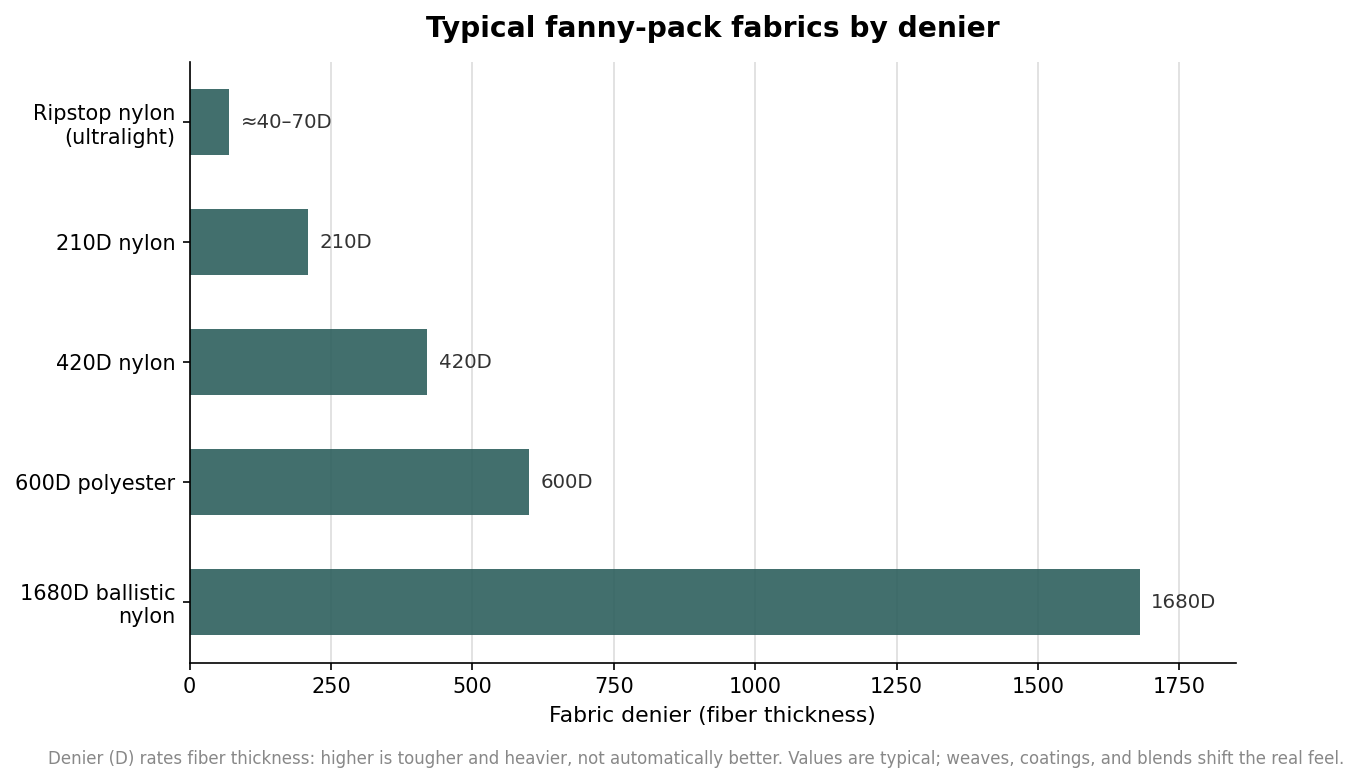
Fabric weight is quoted in denier, written with a D, and it measures how thick the yarn is rather than how the pack will feel in hand. An ultralight ripstop nylon around 40 to 70D keeps a pack featherweight and packable but scuffs sooner; a 600D polyester is the workhorse of promotional packs because it resists abrasion and holds a printed graphic crisply; a 1680D ballistic nylon is nearly indestructible and priced and weighted to match. Higher denier is tougher, not automatically better — a giveaway pack in 1680D is overbuilt, and an everyday carry in 70D ripstop will not last.
Water resistance comes from the coating, not the denier. A PU or TPU coating on the back of the fabric is what actually sheds a drizzle, and it is worth asking about separately, since two 600D packs can behave very differently in rain depending on whether one is coated. Recycled polyester is now common and performs close to virgin polyester for most uses, which makes it an easy substitution if sustainability is part of the brief.
Hardware decides whether it lasts
Zippers and buckles fail long before fabric does, so they deserve as much attention as the shell. Look for a molded or coil zipper in the #5 or #8 range — the number refers to the tooth width in millimeters, and heavier packs want the larger size for smooth, durable operation. A branded YKK-type zipper is a reliable marker of quality at this price point. For the closure and strap, a side-release buckle is more secure and longer-lived than a hook-and-loop flap, which loosens as lint collects in it.
The webbing strap should adjust across a wide range so one pack fits most bodies. A belt that runs from roughly 28 inches out to 48 inches covers the large majority of adults and lets the same pack be worn at the waist or slung across the chest. Confirm the buckle is rated to the strap width and that the webbing is bar-tacked where it meets the body, since that seam takes the load every time the pack is cinched.
Choosing a decoration method
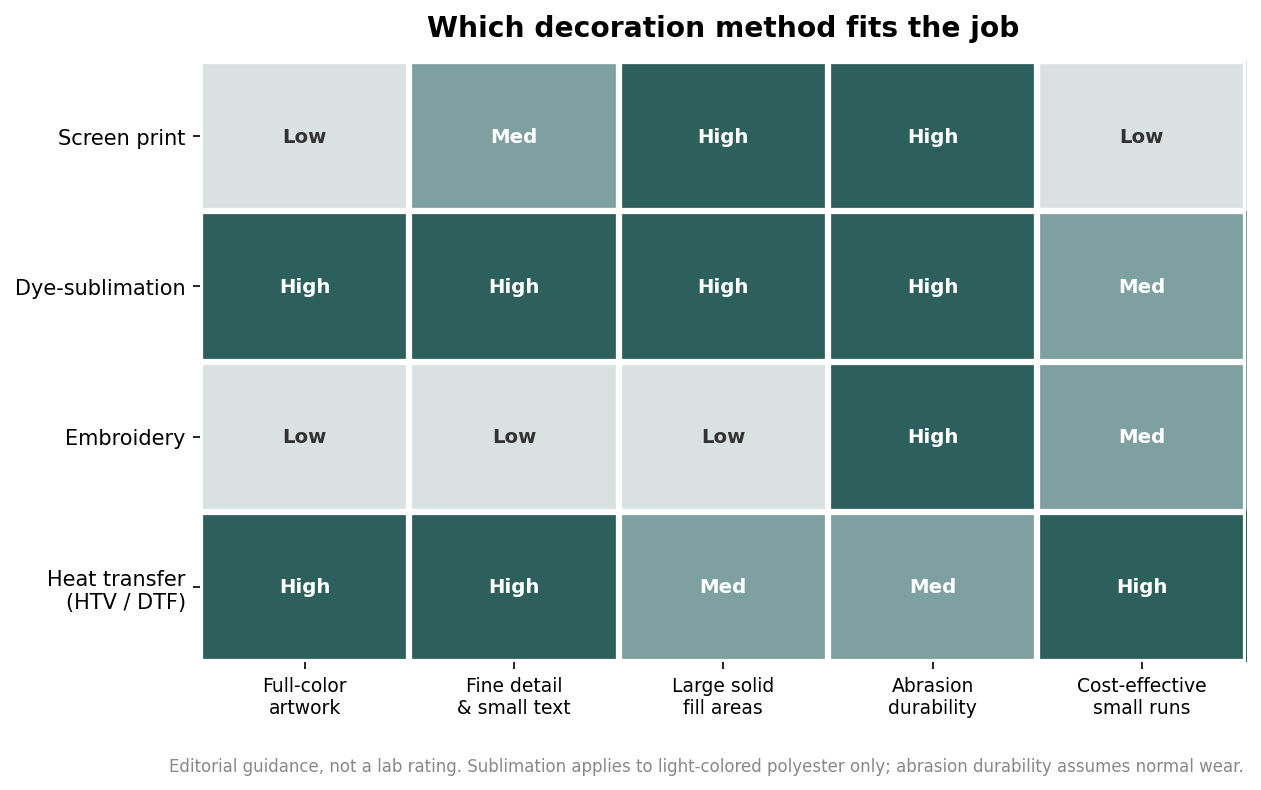
How the logo goes on is where custom packs most often go wrong, because the method that looks best on a flat sheet is not always the one that survives a curved, zippered panel. The four common routes each have a job they do well. Screen printing lays down durable, punchy spot colors and is economical once the screens are set, but it struggles with photographic art and fine gradients. Dye-sublimation dyes full-color, edge-to-edge graphics into the fibers so nothing cracks or peels, but it works only on light-colored polyester. Embroidery reads as premium and is extremely durable, yet it cannot hold small text or fine detail and adds bulk. Heat transfer, including HTV and DTF, prints full color in small runs with sharp detail, at some cost to the long-term abrasion resistance of the print.
The grid below maps those methods against the demands a design usually places on them. Match your artwork to the row that scores well where it matters: a photographic festival graphic points to sublimation, a one-color team logo on a dark pack points to screen print or heat transfer, and a subtle corporate mark on a premium giveaway points to embroidery.
Print area and artwork limits
A fanny pack gives you less usable print space than its size suggests. The front panel is small, curved, and interrupted by a zipper, so the practical print area is often only about 4 to 6 inches wide depending on the silhouette. Center the artwork on the flattest part of the panel and keep critical elements clear of seams, zipper tape, and the buckle, because decoration bridging a seam distorts and wears first. Simple, high-contrast marks hold up far better at this scale than dense, detailed lockups that shrink into mud once they are sized to fit.
Quantities, lead times, and the sample that saves you
Minimums vary widely by supplier and method. Premium blank packs can be bought one at a time, while decorated promotional runs typically carry a per-design minimum because screens, sublimation setups, or embroidery digitizing have to be paid for once and then amortized across the order. A common production window runs about 10 to 14 days after art approval, with rush service usually available for a fee. Those figures are indicative rather than fixed, so confirm both the minimum and the lead time in writing before you build a launch date around them.
Whatever you decide, order a single decorated sample before the full run. A physical pack tells you in ten seconds what a proof cannot: whether the color sits right on that fabric, whether the print clears the seams, and whether the zipper and buckle feel like something you would want your name on. The cost of one sample is trivial next to reprinting a few hundred packs that came back wrong.