A branded waist bag is one of the highest-visibility promotional items you can put your logo on, but the phrase now covers four distinct silhouettes, and choosing the wrong one for your audience wastes both budget and prime print space. The fanny pack, the belt bag, the sling, and the crossbody share the same DNA, yet each is worn differently, holds a different amount, and presents your artwork at a different height on the body. Getting that match right is the difference between a bag people actually wear out and one that ends up in a drawer.
The four silhouettes, defined
A fanny pack is the utility original: a single adjustable strap that buckles around the waist or hips, with the pouch riding low at the front, side, or back. Construction is straightforward and the emphasis is on function, which is why it dominates festival, event, and giveaway orders. A belt bag is, mechanically, often the same object worn higher on the torso or across the chest, but the term signals a fashion rebrand. Belt bags lean on structured shapes, cleaner proportions, and premium materials, and they are styled as an accessory rather than a tool. If you strip away marketing, the practical differences between the two are usually materials and how the customer wears it.
A sling breaks from both. It is a larger single-strap bag worn diagonally across the back or chest like a one-strap backpack, so it sits higher, carries more, and suits hands-free travel or day hikes. A crossbody is the most bag-like of the group: a purse on a long strap worn diagonally and not clipped at the waist at all. It offers the most capacity and the least sporty look, and it frequently uses a flap closure rather than a top zipper. As a rule of thumb, capacity and strap length climb as you move from fanny pack to belt bag to sling to crossbody, while the sporty, utilitarian feel drops off in the same direction.
Where your logo actually shows
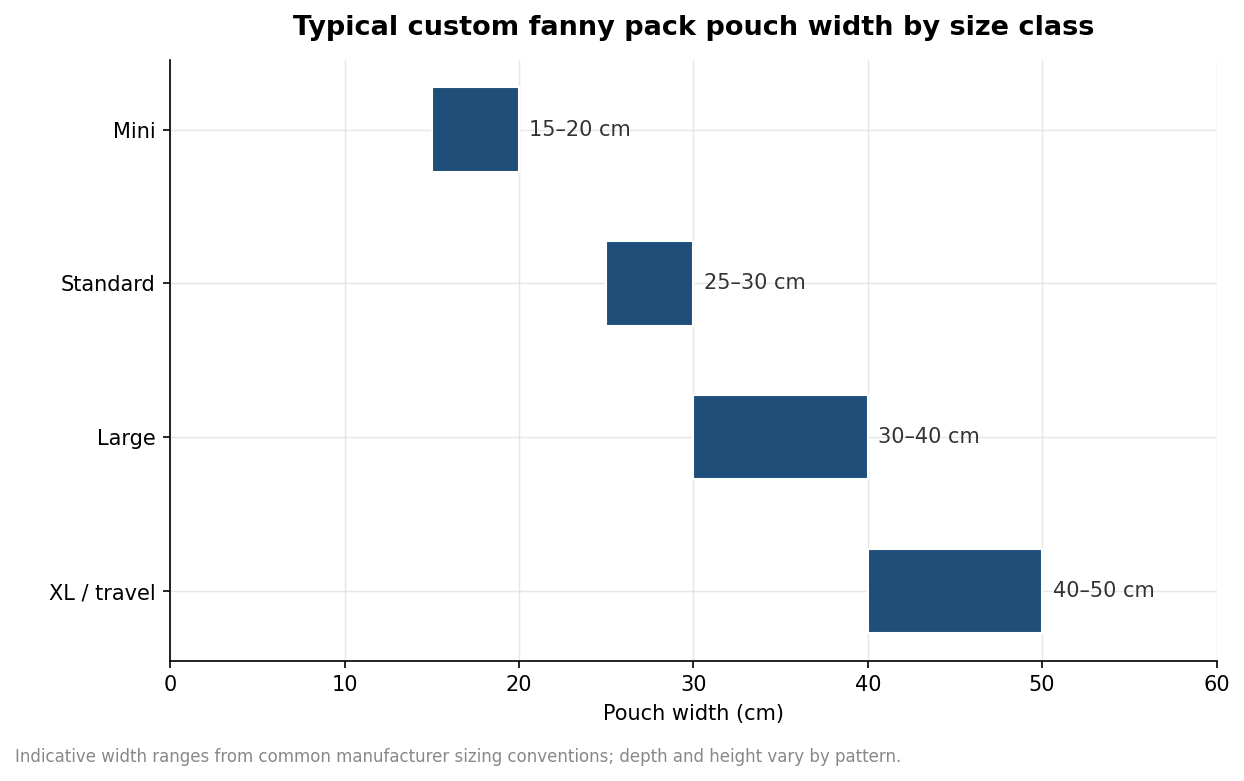
Silhouette decides how your branding reads. A fanny pack presents a flat front panel roughly five to seven inches wide at hip height, which is ideal for a single bold logo or a wordmark that people see as the wearer walks past. A belt bag worn across the chest lifts that same panel closer to eye level, so finer detail and embroidery pay off. A sling gives you the largest uninterrupted canvas of the four, good for full-panel dye-sublimation or a large screen print, while a crossbody’s flap often cuts usable print area in half, pushing you toward a smaller emblem, a woven label, or hardware branding instead.
Match the decoration method to that canvas. Screen printing is economical and crisp on flat woven panels for one to three spot colors. Embroidery reads as premium and holds up to washing, which suits belt bags and corporate gifts. Dye-sublimation prints edge-to-edge, full-color, all-over graphics but works only on polyester, making it the natural choice for loud festival and team pieces. Beyond the panel, branded zipper pulls, custom-molded buckles, jacquard webbing, and rubber or leather patches let you carry the brand into the hardware, which is often what separates a giveaway from something people keep.
Materials and hardware that survive daily wear
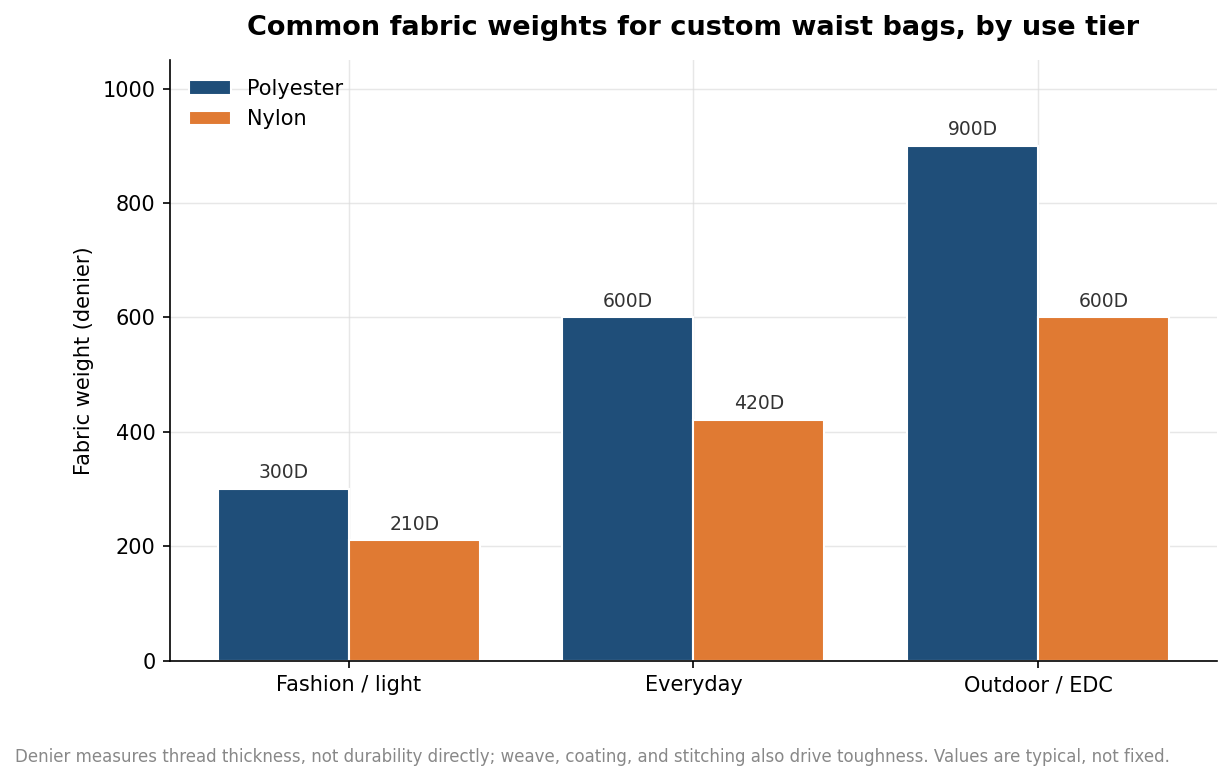
Fabric is where cost and durability are decided. The two workhorses are nylon, typically specified at 210D, 420D, or 600D, and polyester, usually 300D, 600D, or 900D. The “D” is denier, a measure of thread thickness rather than a direct durability score, so a heavier number is not automatically a tougher bag; weave, coating, and stitching matter just as much. Nylon tends to be stronger and more abrasion-resistant for a given weight, while polyester holds printed color better and costs less, which is why it dominates fashion and mass-market runs. Ripstop adds tear resistance for running and hiking pieces, oxford weaves and PU coatings add water resistance, and canvas or faux leather push a bag toward a premium retail look.
Hardware quietly determines whether a bag lasts a season or a year. Webbing commonly comes in 25mm, 32mm, and 38mm widths, with the wider straps reserved for larger or outdoor bags where comfort matters; nylon webbing is the strongest option. Specify a known zipper such as YKK or SBS, since a failed zipper effectively ends the bag’s life, and choose acetal or Duraflex side-release buckles over generic ABS for straps that get clipped and unclipped daily. Details like tri-glide adjusters, D-rings, and bartack stitching at the strap anchors and other stress points are cheap to add and are exactly the points that fail first when they are left out.
Matching the style to the use case
For festival and event merch, a polyester fanny pack with all-over dye-sublimation gives you the loudest, most photographed piece per dollar, and the low ride is part of the look. For corporate gifts and retail resale, a belt bag in a heavier polyester, canvas, or faux leather with embroidery reads as something worth keeping rather than a throwaway. For running and outdoor use, a slim ripstop fanny pack or a compact sling with a bounce-free fit and water-resistant zippers is the priority, and print can stay minimal. For travel, a larger sling or crossbody with lockable or hidden zippers wins on security and capacity. And for a high-volume trade-show giveaway, an economical 300D or 600D polyester fanny pack with a one-color screen print keeps the per-unit price down while still putting your name at hip height in every hallway.
One sizing detail people forget
Strap length quietly decides whether a bag fits your whole audience. Waist and belt bags typically ship with adjustable straps spanning roughly 33 to 60 inches or more, and the working rule is simple: waist measurement minus bag length equals the strap length a person needs. If your audience skews toward plus sizes or you want the option of chest-across wear, confirm the maximum strap length before you approve a sample, and consider ordering an extended-webbing option. Crossbody and sling straps run longer still, commonly 85 to 120 centimeters, and a few extra inches of adjustment costs almost nothing at production while dramatically widening who will actually wear the finished bag. These figures are indicative ranges rather than fixed standards, so treat the physical sample, not the spec sheet, as the final word before you commit to a full run.